

You made it to Book Club week 3!
I’ve been so encouraged by the dialogue our reading has spurred, both here on the Substack and in person as our paths have crossed out in the wild. I know this book is outside of many of your typical reading rotations, but I think it’s good for us to be stretched and to dig into the source material—the works that have had so much influence on how we understand the Faith today.
That’s one of Book Club's purposes: provide you with a community to read the great books that you might have otherwise regarded as too intimidating to tackle yourself. I hope reading this gives you the confidence and inspiration to read more of the Church Fathers as well!
In Chapter 2, Athanasius laid out for us the “first cause of the Savior’s becoming Man.” Here in Chapter 3, he explains more of the reasons our God became Man—namely, to reveal God to Man and to renew Man after His own Image.

“knowledge of their Maker is for men the only really happy and blessed life” (p. 58)
Before Nebraska’s slogan was changed to the quippy, “Honestly, it’s not for everyone,” it was:
“The Good Life.”
We all want the Good Life; and fortunately for you, it isn’t only found in Nebraska. Ha.
Athanasius explains that the Good Life—“for men the only really happy and blessed life”—is found in knowing God. Two passages come to mind:
“this is eternal life, that they know you, the only true God, and Jesus Christ whom you have sent.” (John 17:3)
and
“You make known to me the path of life; in your presence there is fullness of joy; at your right hand are pleasures forevermore.” (Psalm 16:11)
The good life, the happy life, the blessed life, eternal life are all found and experienced in knowing God.
This is not just a knowing about God, this is a knowing God.
In his book, Room for Good Things to Run Wild, Josh Nadeau says,
“If pictures are worth a thousand words, then a kiss can fill a library.”
See the difference? The Good Life is not found in amassing a collection of facts about God, or simply being in the place where He is worshiped. The Good Life is found in relational participation and personal worship. It’s the difference between looking at a picture of my wife and sharing a kiss with her. I think you see the distinction.
And that’s what we see in the Psalm above: in God’s presence is where we experience maximum joy; at His right hand is where our longing for pleasure is eternally satisfied.
We have to be with Him, near Him, in Him, and He in us. This is The Good Life.
And this is what Athanasius says Man’s Image bearing is meant for:
“in fact, the good God has given them a share in His own Image, that is, in our Lord Jesus Christ, and has made even themselves after the same Image and Likeness. Why? Simply in order that through this gift of Godlikeness in themselves they may be able to perceive the Image Absolute, that is the Word Himself, and through Him to apprehend the Father” (p. 58)
Man was made to know God—to see Him, to reflect Him, to live in eternal fellowship with Him.
But as we saw in Chapter 1, Man discarded their Birthright of Beauty. Instead of clinging for dear Life to the Source of maximum and eternal joy, they sought pleasure and Life in lower things—“worshipping the creature rather than the Creator” (Romans 1:25).
On top of that, Man also neglected the unique gift given to them:
“they seemed rather to be brute beasts than reasonable men, reflecting the very Likeness of the Word.” (p. 60)
I think the way Athanasius describes the consequence of our fall is fitting:
“dehumanizing of mankind.”
To be Human is to bear His Image as we were designed; and as we rebel from that design in any number of ways, we become less human—looking less and less like the way God designed us.
We need to be renewed, re-created, restored to our designed purpose. But how? Who could do this?
Could men? No, for they were only made after the Image.
Could angels? No, for they share not in the Image.
“The Word of God came in His own Person, because it was He alone, the Image of the Father, Who could recreate man made after the Image.” (p. 62)
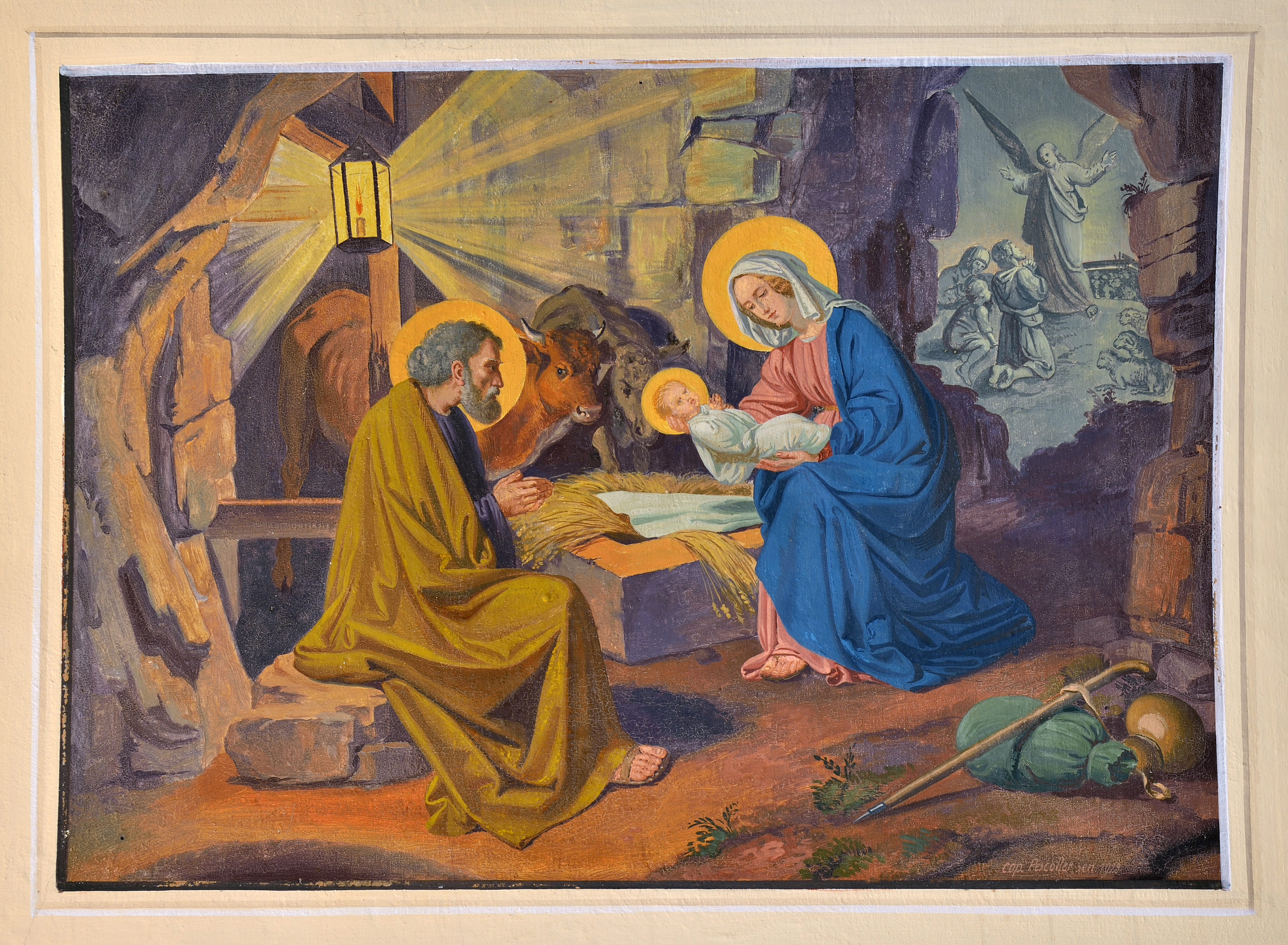
In the Word taking on flesh, the two great tragedies of our fall mentioned in this chapter are reconciled—Man’s losing their knowledge of God and Man’s failure to fulfill their designed purpose.
Man’s knowledge of God restored:
Jesus says, “Whoever has seen me has seen the Father.” (John 14)
Jesus is the Image of the Father, the exact imprint of His nature. He reveals the Father. He makes God known to us again.
“taking to Himself a body like the rest; and through His actions done in that body, as it were on their own level, He teaches those who would not learn by other means to know Himself, the Word of God, and through Him the Father.”
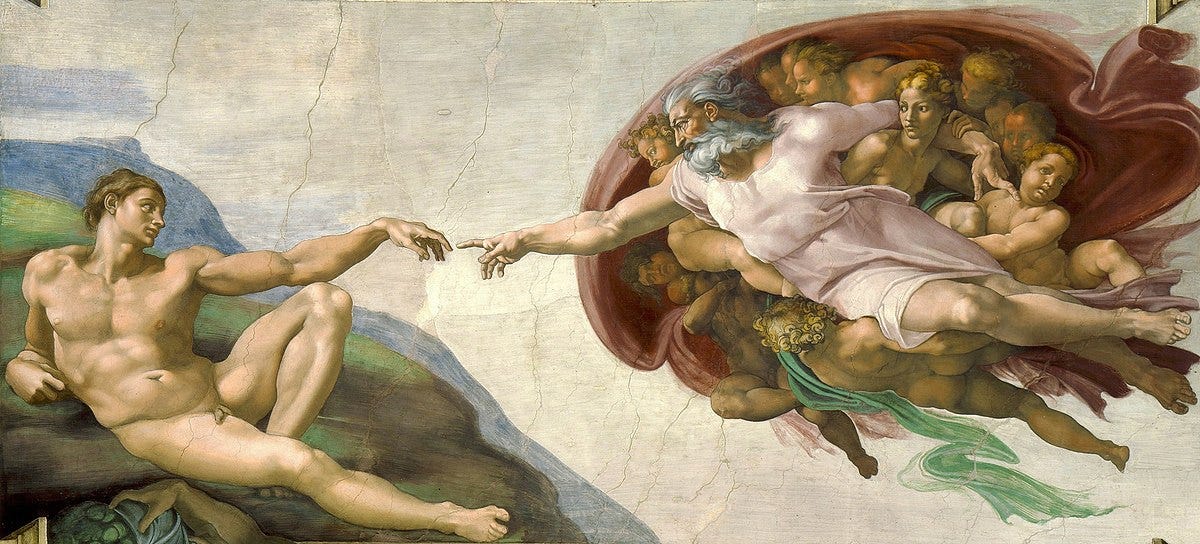
Like in Michelangelo’s painting at the top of the page, God created Man and maintains His reach for unity; but the finger of Man drops—our gaze lowers and looks for Life among creation.
And so, in love, God enters creation where our eyes and hearts have drifted—mercifully taking a form which our senses could apprehend.
“From such ordinary acts as being born and taking food, He was recognized as being actually present in the body; but by the extraordinary acts which He did through the body, He proved Himself to be the Son of God.” (p. 69)
He meets us on our level by taking for Himself a body He created to dwell in. He reveals God to us by using that body to manifest His glorious divinity.
Man’s design restored:
Paul tells us in 2 Corinthians 5, “if anyone is in Christ, he is a new creation. The old has passed away; behold, the new has come.”
Man must be renewed, re-created, born again.
“He was not referring to a man’s natural birth from his mother, as they thought, but to the re-birth and re-creation of the soul in the Image of God.” (p. 63)
“He assumed a human body, in order that in it, death might once for all be destroyed, and that men might be renewed according to the Image.”1
Through faith in Christ, “by the washing of regeneration and renewal of the Holy Spirit”2, our souls are raised from Death to Life—the beginning of our total restoration to properly bearing the Image of God, the resurrection of the body in the End being its completion.
Because He came, we know God again; and we can reflect Him as we were designed.
The Good Life has been restored. Amen.
Let’s hear from you now.
Did you collect any new insights about Jesus from this chapter?
Did this chapter affect your view of what “The Good Life” truly is?
What did you think of his explanation of how the Divine Nature of Christ and the Human Nature of Christ coexist?
What questions are still lingering in your mind after reading?
Next week’s reading will be Chapter 4. See you there!


Emphasis mine.
Titus 3:5b
!!!!! This book is fantastic and has really helped me understand the Gospel more fully and clearly. Absolutely beautiful!
I think the thing that stands out for me in this chapter is the fact that Jesus WANTS to be known by us!!! As it states in pg. 57, He could have left us destitute of the knowledge of Himself, but He chose to pursue us despite our denial of Him and our wanderings. I see more clearly His heart and relentless pursuit of man — a desire for man to be in relationship with Him, by sending the only One that could recreate the image of the Father, to bring anew the heart of man. And on top of this beautiful truth, He reveals Himself to man in numerous ways. Amazing!!!
Another Gospel connection I had was that part of the reason God sent Jesus to earth as a man, was because man was searching for God among created things rather than the Creator. Romans 1:23. I am moved by how generous our God is.
Question to work through:
Angels don’t carry the image of God? Someone share some scripture and walk me through this please!
So enjoying this reading!!
Again I am reminded how God is so relational and personal. He desires to be known; He is not a far-off God. Page 59 gets into this, "He had not hidden Himself from the sight of men, nor given the knowledge of Himself in one way only; but rather, He had unfolded it in many forms and by many ways." God has given us so many opportunities to see Him and know Him. Praise Him! This is so very different from every other religion and it burdens my hear to know that so many people are devoted to gods who don't love them and don't care about them. If only they knew the Truth!
As Athanasius explains on page 65, humans have looked to the created to find objects of worship, among the 'things of sense.' This made me think of 1 Samuel 8. Where the people of God are desiring a human king to judge and govern them, because they had rejected God as their king. They were turning to the created, to the things of sense. Yes, God does give them earthly, purely human kings but eventually and ultimately He gives us King Jesus, the God-Man. He answers their desire with Himself. He gives us a human king who can perfectly rule and govern as God, but also reveals God to us in a very personal way.
Questions:
Page 59 states that "being made in His image was sufficient to give them knowledge of the Word." Is this referring to a conscience that all humans have? Just because we are made in the Image and are 'reasonable,' that should point us to the Creator? I think of Romans 2:14-15, that everyone has a conscience and should be able to see how their conscience points to a creator. Is this what Athanasius is saying here?
Page 67 speaks of Jesus's omnipresence. I understand how Jesus's mind is not contained, how He is still upholding the universe with the word of His power. But I am curious if this means He was also present in heaven while His body was doing ministry on earth? Or is it that He was only physically present in one place but spiritually present everywhere? How does this work?