

Less than a week until Christmas day.
You’ll likely be seeing family, preparing food, and grabbing last minute gifts. You’ll be hearing music on the radio and television and in shopping malls singing of the wonders of the Incarnation—the entry of God into the world through the womb of a virgin.
And as you gather and listen and sing, the words of Athanasius will be fresh in your mind—the words which are his “offering to you who love Christ, a brief statement of the faith of Christ and of the manifestation of His Godhead to us.” (p.145)
I hope his offering enriches your Christmas season—your conversations with family, your worship services, your private meditation. I hope it draws you to marvel even more at the glories of the Incarnation.
“For, indeed, everything about it is marvelous, and wherever a man turns his gaze, he sees the Godhead of the Word and is smitten with awe.” (p. 142)
Look around and be smitten with awe, friend.
Direct your gaze up to the stars—the heavens which declare the glory of God—and be smitten by the One who set them in place, yet cares for you, son or daughter of man.
But if you “cannot look so high as heaven, but only so far as men (p. 125),” be smitten by the Word made flesh—God become Man. See the works of the God-Man: overpowering all spiritual forces of evil, making men able to embrace virtue, and putting an end to Death and decay through the work of His cross and resurrection.
Jesus has show that the “gods” which humanity was drawn to worship are no gods at all—those “gods” who lie and cheat and murder, and which hold humanity captive to Death. He proves that He alone is God—the sole God who is Just and Good, calling Men to the same Justice and Goodness.
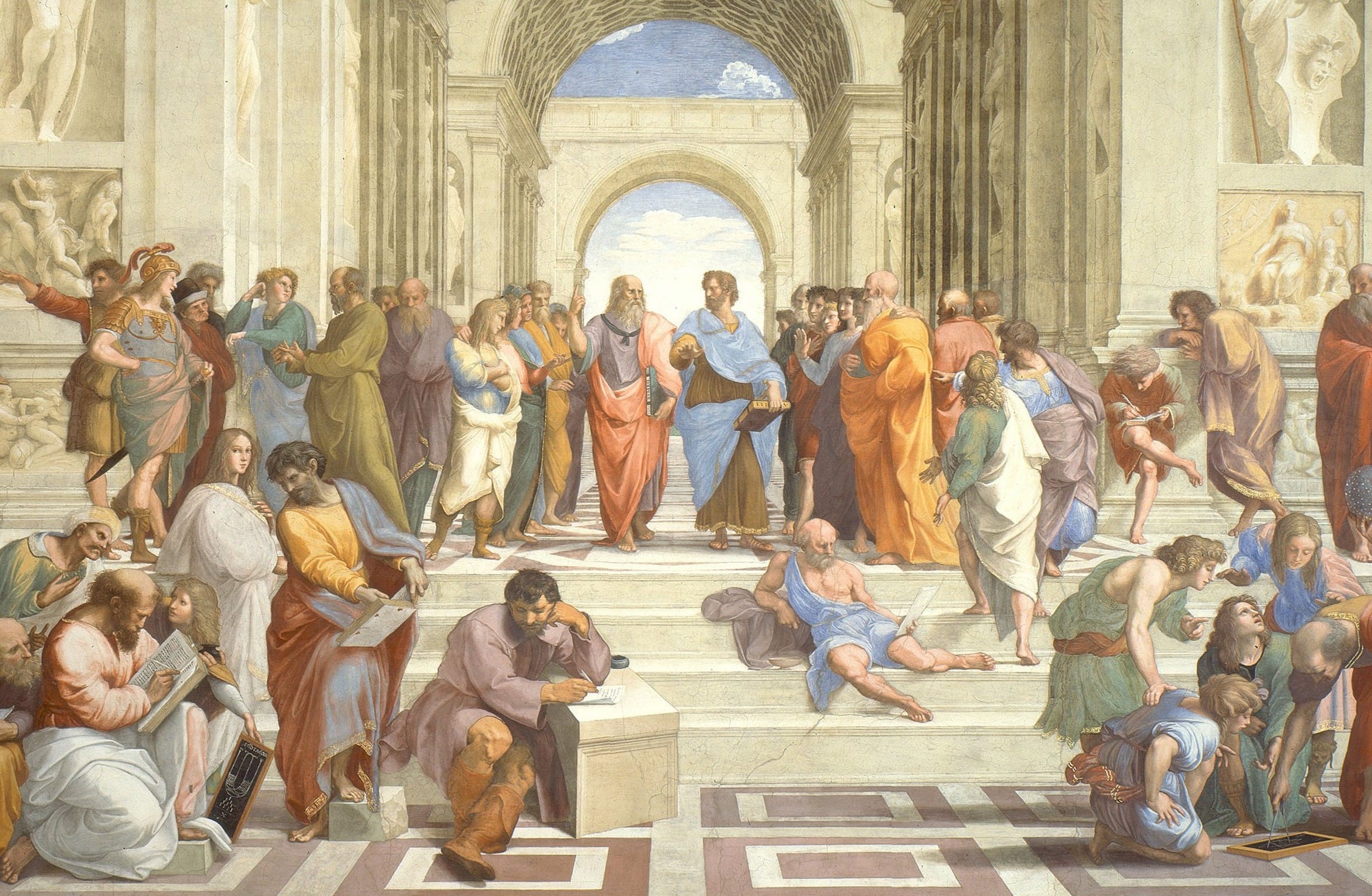
This Justice is what those greats among the Greeks sought to propagate among humanity, but to no avail. Plato wanted people to see that the fullest life is found in the relentless pursuit of Virtue and Truth. Socrates was put on trial by jealous and murderous adversaries claiming that he was “corrupting the youth and turning the people to worship a different god.”
He defends himself before the courts of Athens in Plato’s Apology, proclaiming:
“My excellent friend, you are an Athenian, a citizen of this great city, so famous for wisdom and strength, and you take every care to be as well off as possible in money, reputation, and place—then are you not ashamed not to take every care and thought for understanding, for truth, and for the soul, so that it may be perfect?”
Socrates was pointing out to the people that their priorities were not properly aligned. They cared so much for their status and wealth and condition of living, but cared nothing for spiritual things—living virtuously while pursuing Truth and Goodness.
But they did not listen to Socrates; they killed him.
“the Greeks failed to convince even a few from their own neighborhood in regard to immortality and the virtuous ordering of life.” (p. 130)
And Christ too was killed for His witness to the Truth. He was jealously delivered over for blasphemy and corrupting the people. But our resurrected Christ could not be defeated by death like our friend, Socrates, was.
After rising from the dead, “Christ alone, using common speech and through the agency of men not clever with their tongues, has convinced whole assemblies of people all the world over to despise death, and to take heed to the things that do not die, to look past the things of time and gaze on things eternal, to think nothing of earthly glory and to aspire only to immortality.” (p. 130)
Where the wisest and most eloquent of philosophers gained no ground in turning humanity to Truth and Goodness, Christ accomplished exactly this all over the world through a group of uneducated men with no formal training or credentials.
He used their weakness to prove His strength. And His work in the church bears witness to the Living God who did not stay dead when murdered 2000 years ago, but rose and is now actively building His Kingdom and making men to embrace Virtue, Goodness, Justice, and Truth through the washing of regeneration and renewal of the Holy Spirit.
“If, then, the Savior is neither a mere man nor a magician, nor one of the daemons, but has by His Godhead confounded and overshadowed the opinions of the poets and the delusion of the daemons and the wisdom of the Greeks, it must be manifest and will be owned by all that He is in truth Son of God, Existent Word and Wisdom and Power of the Father.” (p. 132)
No “god” can stand before Him.
All the world’s wisdom is made foolishness by Him.
As their own poets have said, “In him we live and move and have our being.”
They have only to understand that the One they speak of—the One who created and sustains all that exists—is the Man, Jesus Christ. He is the Source of all Being, Goodness, Truth, and Beauty. He is Being, Goodness, Truth, and Beauty.
I think this is the thought that John picks up on in his gospel.
“In the beginning was the Word, and the Word was with God, and the Word was God. He was in the beginning with God. All things were made through him…”
John is drawing his Jewish readers to the idea we find in Genesis, where God speaks and creation comes into existence. The co-eternal Word of God is powerful, and Jesus is that powerful Word of God through whom all things were made.
But John is writing his gospel in Greek, and that Greek term he uses for “Word” is Logos. This word—Logos—is a charged with meaning in Greek philosophy. Logos was thought of as some divine reason or force which ordered and sustained the universe, making sense of and holding all things together.
And like Paul’s appeal to the Athenians in Acts 17, John is essentially saying, “What therefore you worship as unknown, this I proclaim to you.”1
“the Word became flesh and dwelt among us, and we have seen his glory, glory as of the only Son from the Father, full of grace and truth.”
John proclaims to his Greek readers, “The Word (Logos), which you believe is the foundation and divine orderer of the universe is the Word of God which I proclaim to you, who became flesh in the Person Jesus Christ, and dwelt among us and died for our sins and rose from the dead that we might rise with Him.”
John the Baptist prepared the Jews to receive their Savior by preaching of the One who was to come after him.
Plato and Socrates prepared the Greeks to receive their Savior by teaching their incomplete understanding of the Divine Logos.
John the Apostle steps in to finish their work, proclaiming to both Jews and Greeks that Jesus is the Self-Existent, Eternal Word of God who created all things and became a man that He might re-create all things.
And this Jesus calls out to our dead and dying world, “Come to me, all who labor and are heavy laden, and I will give you rest. Take my yoke upon you, and learn from me, for I am gentle and lowly in heart, and you will find rest for your souls.”2
Go to Jesus and find rest for your soul.
Idols will not satisfy. Empty philosophy and worldly wisdom will not satisfy.
Only Jesus can satisfy our deepest longings. For we were made for Him; and our hearts are restless until they rest in Him.

“so many are the Saviour’s achievements that follow from His Incarnation, that to try to number them is like gazing at the open sea and trying to count the waves.” (p. 141)
We have reached the end of this book club’s study of On The Incarnation, and have only begun to see the beauty of the Incarnation of the Word. There are more to discover than we can see now; and as we continue to search, more will be unveiled like waves that endlessly flow from over the horizon, breaking on the shores of our hearts.
I love Athanasius’ encouragement in his conclusion to continue studying the Scriptures—that this book is only a beginning of Macarius’ search for Truth. He must go on in devoting himself to the study of God’s Word and the practice of Virtue which we were designed for, and which Christ has set us free to.
May we take heed of Athanasius’ exhortation as well.
I pray we do.
And I hope this study was a blessing to you. I hope you leave smitten with awe as you beheld the Godhead of the Word. I hope it moves you to the virtuous imitation of Christ through which God is renewing us.
I hope.
I want to hear from you now!
I’d love to hear what you thought of these chapters, and the book as a whole.
I’d also appreciate any feedback or suggestions to improve Book Club or Gospel Coffee Club in general.
It will likely be a bit before the next Book Club kicks off; and the next book has not been decided on yet, so send me your suggestions/requests if you have them!
Farewell, friends. I hope you have a merry Christmas, celebrating the Incarnation of God our Savior!


Acts 17:23b
Matthew 11:28-29
What a beautiful post to conclude this study 👏
I enjoyed reading this book, but am grateful I wasn't alone on this venture. I'm not sure I would have gotten through it solo tbh 😅 My bro was wrapping up the last chapter yesterday and it encouraged me to finish it up myself 😁
Dagger to the heart on pages 119&120:
"Men alone having rejected what is good, have invented nothings instead of the truth."
Invented nothings ... I don't know if it's funny or sad. We couldn't submit to Truth, couldn't even figure out partial truths; nothing. And, even worse is when others are led away from Him to ... invented nothings.
Oh, how His grace covers His children 🙌 So, so thankful 🙏
--
Page 131 succinctly expresses my feelings of being smitten with awe by Jesus:
"Who, then, is this Christ and how great is He, Who by His Name and presence overshadows and confounds all things on every side."
His Name holds power and grandeur! His Presence is all I need (though I all too often forget that).
--
The small conclusion chapter held two things I really liked:
"This will give you a beginning, and you must go on to prove its truth by the study of the Scripture." Page 145
I love Biblical fiction (Francine Rivers and Jill Eileen Smith are my two favs - yas!), but my husband is not in agreement 😂 He also doesn't like the show The Chosen, which I also argue is Biblical fiction. We just watched King of Kings with our kids last night, which is also Biblical but fiction nonetheless.
All that to say! I love my books because it leads me right back to the Word. It revives interest and perspective when I'm feeling a little spiritual dryness. But if the books (or TV shows) don't lead me back to the Truth to discover what He actually says, they wouldn't be good. In fact, they might be dangerous.
That's why I love this snippet Athanasius adds. We should be "entertaining" ourselves with messages that lead us back to the true Message.
--
When it comes to reading Scripture, Athanasius on page 146 encourages us to do two things: purify your mind and imitate the author's life. He restates it on page 147 by saying to cleanse your own life and copy the saint's deeds.
I had never heard to do this before. But, serendipitiously, I just started a study of 1, 2 & 3 John. So, I have Athanasius on one side telling me I can be "united in the fellowship of life" with the disciple Jesus loved. On the other side, I have that same disciple encouraging me to have fellowship with him (1 John 1:3&7).
How cool 😎 How miraculous 🙌 How GOD!
Anyway, I have enjoyed all of YOUR fellowship and I pray this year holds deeper intimacy with both God and our spiritual family. I know I need both.
💛