

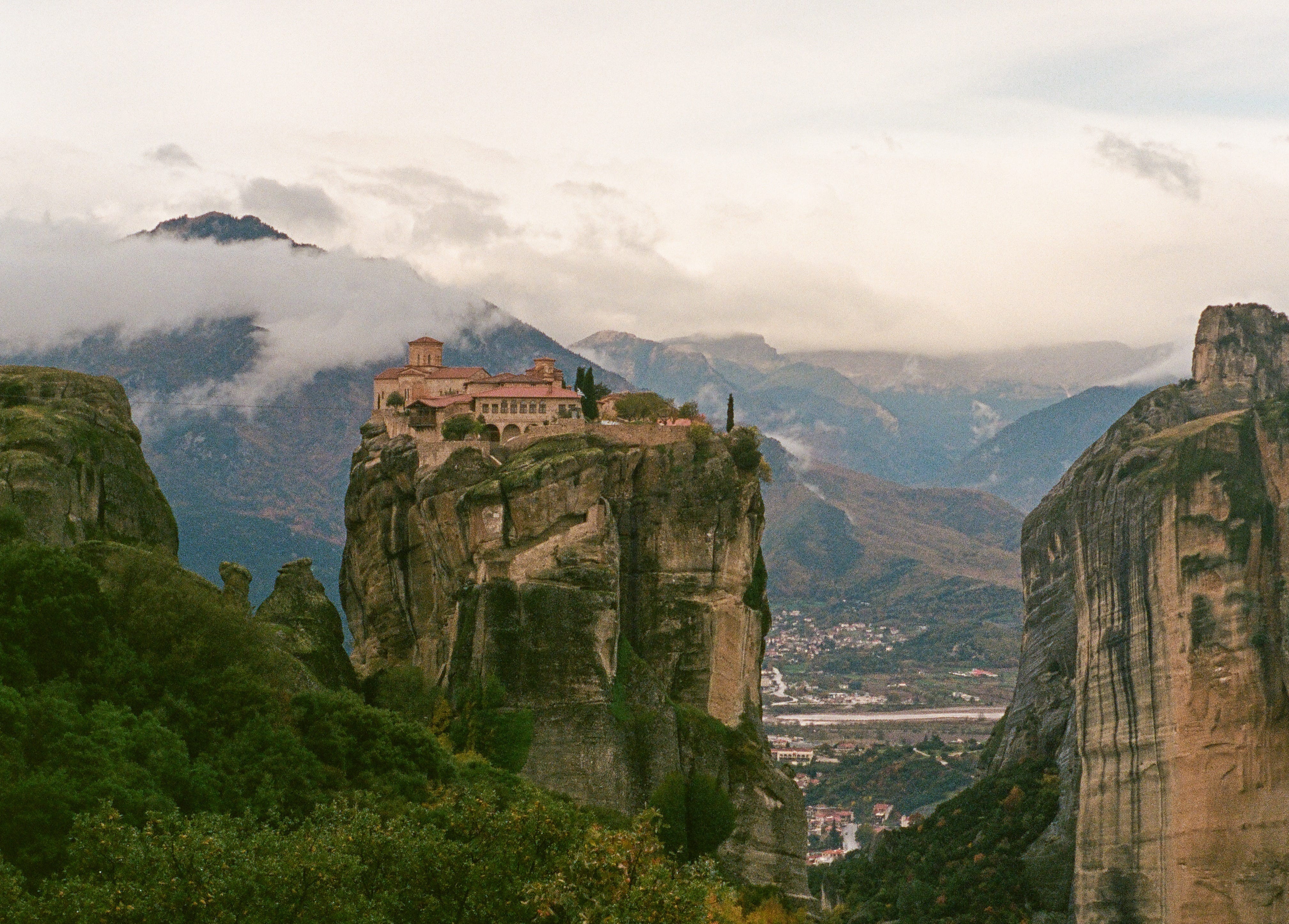
This is a photograph I took on an old film camera last year in Greece. It’s a monastery floating somewhere between heaven and earth. Doesn’t even look real, does it? The context for this photo will come a little later in the post—but for now, behold the beautiful collaboration of God and Man.
How has this summer’s book club been for you? Encouraging? Inspiring? I hope so.
It’s been a joy for me to talk with many of you about how the book has impacted you so far, and the conversations you’ve been having with those you’re reading with.
The Lord is kind. I pray He continues to show us with evermore clarity the goodness of his call to eat, drink, and be merry.

This chapter is brimming with themes of identity, purpose, and calling—some of the most fervent desires of the human soul.
A person is born and immediately begins to orient themselves toward what calls to them, who they are in relation to others, and what they are to do in a world of endless possibilities.
These pursuits are at the core of what it is to exist in the universe as a human being.
The journey, however, can be perilous.
Sometimes the one calling is not Good, but a snake.
There are competing answers to the questions, “who is Man?” and “what is he made for?”
“this world wants to squeeze us into its soul-crushing mold” (p. 57)
The world’s mold has undergone minor updates and alterations, but it has been fundamentally the same since the beginning: anti-human, anti-God deception offering the attributes of God reserved for Him alone, while shaming every proper reflection of God we were made to share in—the fall in the Garden on repeat in the heart of every human being from the beginning until now.
There are voices outside of us—calling to us—which cannot be trusted.
Does that mean we simply need to close ourselves off to those outside voices, and look within ourselves to find our answers to these important questions?
Maybe if we can discern what our “truest desires” are, we could gratify those religiously to find fulfilment. Maybe that’s where we find our identity. Maybe that is our purpose.
But this comes up short again. This approach is self-love, the elevation of self-esteem above all else. We have a not-so-endearing word for people like that: selfish—a quality which is everywhere and always condemned when the proverbial rubber meets the road.
I agree with Ray, “self-esteem at the center of our identity becomes self-distortion.” (p. 55)
Our identity is not something found within, it is something assigned from without.
Our purpose is not something we create for ourselves, it is given to us in accordance with our design.
Our calling is not only what captures our attention, it is a Person inviting us into the plans He has for us.
It is only once we surrender to the Word of God that we will find the answers to these burning questions.
The Word of God tells us who we are, what we are made for, and how to walk the path we are being called down with wisdom.
The Word of God reveals to us our great & high purpose of bearing the image of the Perfect, while also shedding light on the darkest parts of us we never thought would be exposed.
It is the Word of God that gives us true clarity—not the voices in the world and not the voices within ourselves.
You’re a sinner saved by grace, made in the image and being conformed to the Image.
You have the Holy Helper living within you. Ask for help—help to discern between good and evil, help to discern your calling, help to pursue your interests by faith.
This brings me back to this surreal image:
This place is called Meteora, which means “suspended in the air” or “high in the heavens.” We took a long bus ride from Athens through the rural Greek countryside to get there, and found these towering sandstone pillars sprinkled into the edge of the valley.
The Greek Orthodox monastery pictured above is not the only one in Meteora. There are six active monasteries floating atop these rock structures, and as many as twenty-four in the last eight hundred years.
About a thousand years ago, Christian hermits began to climb the rock formations and live in the caves alone, devoting themselves to prayer and private devotion, only coming down to worship communally on Sundays.
Over time, more began to participate and eventually the monastic communities endeavored to build permanent residential structures upon the rocks to live and worship God in the monastic tradition together.
In the middle of the 14th century, the first monastery was constructed: the Great Meteoron. They build wooden scaffolds jammed into the cracks of the rock hundreds of feet in the air. They gathered building materials for years and slowly hoisted them to the top and began construction. Sometimes it took decades to complete.
I’m sharing this with you because at some point, a guy looked up at those stone towers and said, “We are going to build a place of worship, community, and prayer up there.”
I can’t imagine what people must have thought at the prospect of someone building a structure on these rocks, over a thousand vertical feet in the air without modern tools and supplies.
But that man, and many after him, were inspired to begin the work in faith. They had a vision for something beautiful to glorify God and edify Man—they followed their calling however unrealistic the feat appeared.
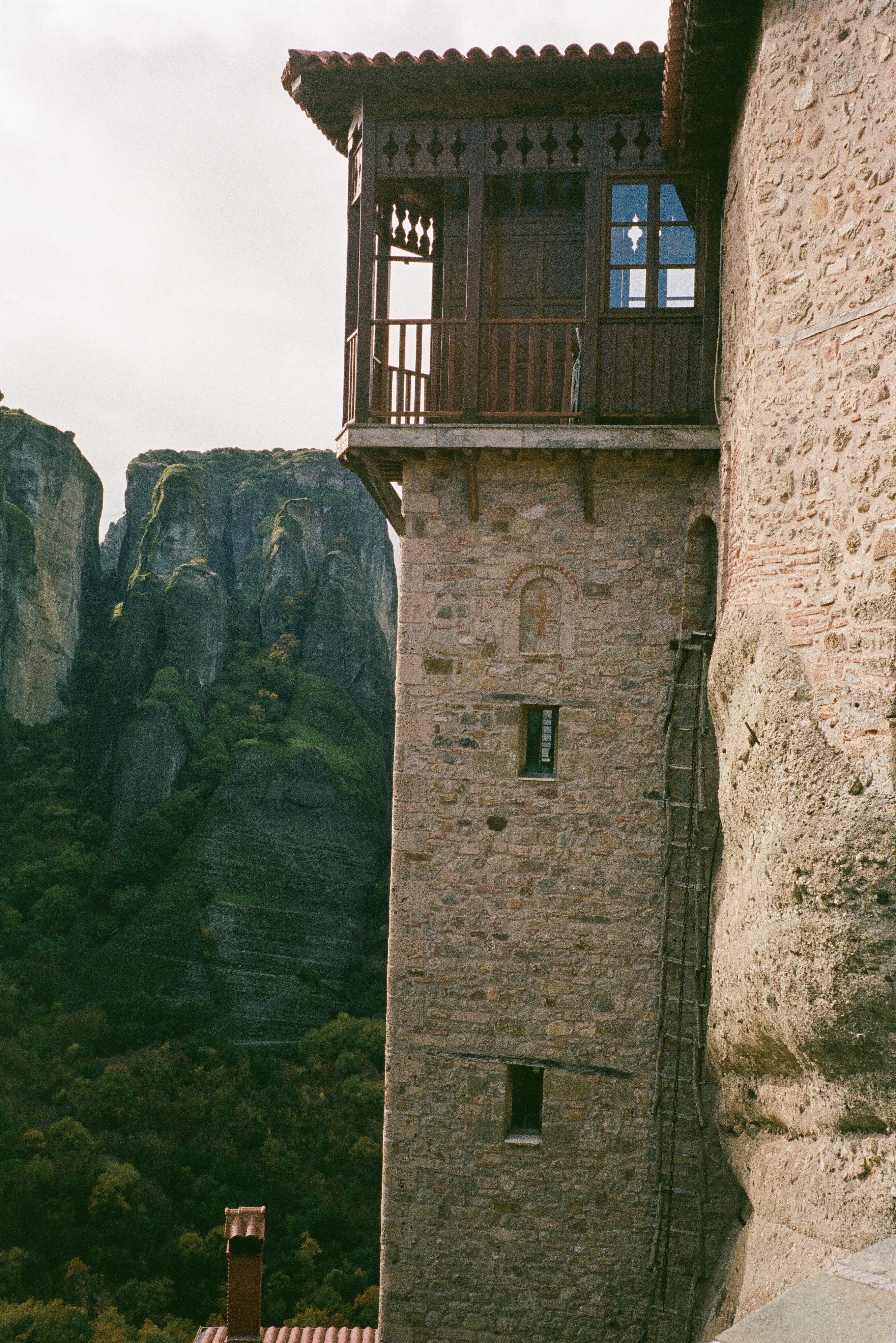
The monasteries were build. God is worshiped. Man is transformed there by the Spirit through prayer, devotion, and life in Christ.
All this because a man, and many other people, faithfully answered the call from God to build these places for Good. They were “lifted by God” (p. 60) into their destiny—led by the Lord into His good and wild plan for their lives.
What is God’s good and wild plan for your life? Maybe not building a monastery in the clouds, but what?
What calls to you? What moves you? What are you noticing that it seems no one else is?
I am fascinated by the idea that we cannot choose our interests. We are simply drawn to what draws us. We don’t have control over that aspect of ourselves, for better or for worse.
You know this. I’m sure you’ve experienced times you tried to be interested in something, but it didn’t work. You just find your attention being captured by the same ideas, problems, tasks, objects, and potential adventures again and again.
It could be that the Lord has made you with certain proclivities and passions, placed in your path certain ideas and circumstances, and is inviting you to heed His call into the adventure of your life with Him.
Who are we to deny Him? “To fold our arms, hold back, and hold out” (p. 59)?
Humbly consider whether your “crazy idea” is not your idea at all, but a call directly from God—and boldly trust in Him to guide you or redirect you when you’ve misunderstood.
It’s hard to know what to do with this life we have been given. But we are friends with One who knows the beginning from the end, who works all things together for Good, and cares for us.
Be humble. Be bold. Answer the call. Fulfill your purpose. Be who God made you to be.
Do you have anything better to do?
I’d like to go on, but I’ll call it there. I’d love to hear from you guys!
What was your impression of this chapter?
Did it stir up anything within you? excitement? fear? confusion? introspection?
How do we discern the call of God to us, from the voices in the world and our own sinful desires?
Do you have an idea of how God may be calling you? Have you stepped into that yet or is something stopping you?
How does knowing that “for all these things God will bring you into judgement” affect the way you move through life and follow your interests?
Share your thoughts in the comments!
See you next Saturday (7/4) for Chapter Five!
I think this was the hardest chapter for me to get behind because I have had so many different paths that I thought God was calling me to go and the door continued to close. The most recent path is the one I am supposed to follow and go back to school to become a counselor. I started the path and was ready to start this summet, but then I stepped out of a job that was not the right fit for the moment. This has made it a little more intimidating to follow in this path and has made it somewhat hard to feel that I am still on the path that God has called me to. I think that the biggest thing that I have to continue to remember what God has shown me time and time again that he is faithful and his plan is greater then mine ever could be. The other thing I have to remember is to find the ways that make my both/and life really worth living p.4.